Thursday, May 30, 2013

How Do I Know If I Need Orthodontics?


Did you know that visibly crooked teeth are not the only reason to take your child to visit Dr. Boschken? There are some subtle things to look for as well, which may indicate the onset of more serious orthodontic issues. Many orthodontic bite situations are much easier to address if they are corrected during a child’s development.

Waiting until facial development is complete or until the permanent teeth have come in can make correction of many orthodontic issues more challenging. Both children and adults can benefit from orthodontic care, but addressing issues early is almost always the ideal choice.

Are you wondering if you or your child might have need for orthodontic care?  Here are some of the most common early conditions to watch for that can indicate the need for an orthodontic evaluation:

• Difficulty when chewing or biting
• Chronic mouth-breathing
• Sucking the thumb, fingers, or any other oral sucking habits that continue after age 6   
• Overbite – when the upper teeth overlap the lower teeth by more than 5mm
• Top front teeth that cover more than 25% of the bottom teeth while biting
• Underbite – when the top front teeth go behind the bottom front teeth when biting
• Crowded, crooked, overlapped, misshapen, misplaced teeth or extra teeth of any size
• Crossbite – when one or more teeth tilt toward the cheek or toward the tongue
• The center of the top and bottom teeth don’t line up
• Uneven teeth-wearing
• Baby teeth that are lost early for any reason
• Mouth discomfort
• Clicking in the jaw joints
• The jaw shifts off-center while chewing or biting
• A jaw that protrudes, or recedes, too much
• Difficulty speaking or enunciating clearly
• Chronic biting of the inner cheek or roof of the mouth
• Asymmetrical facial structure
• Grinding or clenching of the teeth


If you notice that either you or your child has any of these conditions, they could be signs that there is a risk of orthodontic or health problems. The sooner these problems are addressed, the wider and brighter you will be able to smile going forward! We happily provide complimentary evaluations and records and would enjoy hearing form you (408) 225-6660!www.drboschken.com

Thursday, February 28, 2013

Why are teeth sometimes crooked?


There are several reasons why our teeth are crooked or overlaped. Some of us have a small mouth and insufficient room for our teeth, which creates crowding and causes teeth to shift. Some of us are born with upper and lower jaw structures that  aren’t the same size or are malformed. Most often, crooked teeth are inherited traits just as the color of your eyes or hair.
Further causes of crooked teeth are:
  •  the early loss of baby teeth
  •  the loss of adult teeth
  •  continual pressures on the teeth and gums
  •  misalignment of the jaw after a facial injury
  •  childhood habits such as thumb sucking, tongue thrusting, or prolonged use of a bottle or pacifier.
Did you know that having crooked teeth is not solely a cosmetic issue, it can lead to serious health problems as well? Crooked teeth can:

• interfere with proper chewing and contribute to headaches
• make keeping teeth clean more challenging and thereby increases the risk of tooth decay, cavities, gingivitis or tooth loss
• cause undo stress and strain on the jaws muscles, increasing the risk of breaking a tooth!


Orthodontic treatment procedures can help correct crooked teeth, and here at Boschken Orthodontics we have custom services that will meet your individual needs.  We want you to be proud of your smile!


Wednesday, November 14, 2012

The Many Benefits Of Straighter Teeth

Everyone wants a naturally aligned bite and beautiful smile, and it is no secret that orthodontic braces can help you achieve one.  However, Dr. Boschken wants you to know, there are greater benefits to wearing braces than just having straight teeth. You’ll gain many oral health benefits in addition to all of the cosmetic ones.

Tooth Decay and Gum Disease

Crooked or crowded teeth may overlap each other and create very tight spaces. These tight areas can make it quite difficult to brush and floss effectively, and this allows bacteria and plaque to build up. Eventually this build-up leads to tooth decay and gum disease. With orthodontic treatment, your teeth will become properly aligned and the proper spacing will allow for more effective, easier brushing.

Speech Difficulties

Your teeth play an essential role in your speech. When teeth are out of proper alignment or lean too far forward or backward, this can affect your speaking patterns. This may cause embarrassment and/or frustration. Braces can readjust the positioning of the teeth to allow for clearer, more accentuated speech.

Bone Loss

Bone and gum tissues begin to erode when there are no teeth to support. This is also true for poorly aligned teeth. When teeth are misaligned, the crowding or spacing in teeth places too much pressure on the underlying bone structure due to the bad bite. With braces, the bones and tissues are less likely to erode and can continue to support your teeth in their new alignment. This means less bone loss and hopefully much less likelihood of tooth loss both now and in your future!

Digestion

Your teeth play an important role in digestion. Before food ever enters your stomach, it has been broken down in the beginning stages of digestion by your teeth. If teeth are severely out of line, they cannot do their job in breaking down food as effectively as they should. With braces, your teeth will be straightened into optimal alignment for eating and chewing (thus aiding digestion.)

We are here to help you achieve all of your orthodontic goals and provide you and the family with a healthy, beautiful smile! Give us a call for your complimentary evaluation today (408) 225-6660.

Monday, October 1, 2012

No business like FLOSS business

Flossing


Only flossing can remove plaque from between teeth and below the gumline, where some of the worst decay begins. Make sure to floss at least once a day, preferably before bed, to clean the places where a toothbrush can’t reach.
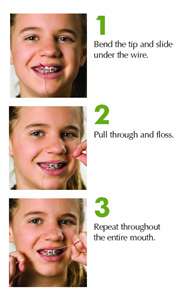
Flossing technique • Tear off about 18 inches of floss, and wind most of it around one of your middle fingers. Wind the remaining floss around the same finger of the other hand. This finger will take up the floss as it becomes used. If you are wearing braces appliances with wires, use a floss threader to maneuver the floss under your wire at every interval between your teeth. As you 'thread' the floss under the wire be sure to:
• Hold the floss tightly (without any slack) between your two hands, with 1/2" to 1" of floss between them. Guide the floss between your teeth using a gentle sawing motion.
• Gently slide the floss into the space between the gum and the tooth until you feel resistance. When the floss reaches the gumline, curve it into a C-shape against the tooth. Do not force or snap the floss.
• Hold the floss against the tooth. Gently scrape the side of the tooth, moving the floss away from the gum.
• Repeat this technique on all of your teeth, and don’t forget the last teeth in back.
• Rinse vigorously with water or mouthwash to remove loosened plaque and particles.
Flossing tips • Establish a regular pattern for flossing so that you don’t miss any teeth.
• As with brushing, flossing should be done gently. Improper flossing can injure your gums.
• If you have not been flossing regularly, your gums may bleed and be sore for the first five or six days. As plaque is broken up and bacteria removed, the bleeding will stop and your gums will heal.
• By age 8, children should be able to floss their own teeth. To make it easier, use a loop of floss. Simply tie the ends of a ten-inch piece of floss, forming a circle. Hold the floss tightly between the thumbs and forefingers, and use the technique above.
• A floss holder can make flossing easier for those who do not have good finger dexterity. Special picks and sticks are also available to help those who find floss difficult to work with. Consult your dentist or hygienist about the best technique for you! Remeber if you are having trouble, we are here to help you @ Boschken Orthodontics! (408) 225-6660

Wednesday, September 26, 2012

Clean Teeth with Braces!

Having braces can present some new challenges when it comes to oral hygiene. Preventing tooth decay can be a big challenge simply because of the tendency for braces to trap food under the wires and between the teeth and the brackets. Here are a few tips to keep your teeth healthy while wearing your braces:

1. Eat Braces-Safe Foods
Keeping your teeth from decay starts with a proper diet. Foods that are high in sugar or starch can cause more plaque which is difficult to remove during your brushing. However there are certain foods that should be completely avoided while wearing your braces.
First, sticky foods like caramel or gum can get stuck in your braces and be difficult to remove during brushing. Next, hard foods such as nuts and candy could bend wires or even break a bracket. Foods that are firm or hard to bite into like apples, carrots, or corn on the cob should be avoided or cut into tiny mini bites. As much as we like to snack on them, those crunchy treats can harm your braces. Things like chips, ice, popcorn can also bend or break your braces. The good news however is that bananas, mangoes, milk, water, poultry, and pasta all tend to be low in enamel-busting acids.

2. Proper Brushing is essential

You'll want to place your toothbrush at a 45-degree angle against the edges of your gums in order to clean the whole tooth, and brush gently in the area between the wire/brackets and your teeth. Use a soft toothbrush and alway use fluoride toothpaste for best results. Rinsing several times every day will help keep your mouth cleaner too! Rinsing is especially important when you have braces as you need to disinfect your entire mouth, including those spots under the braces where your brush can't always reach.

3. Ask Boschken Orthodontics about special cleaning tools

There are special brushes and flossers designed to help you get around and under the appliances in order to clean your braces. You can also find many of these items at your local pharmacy. Look for Proxa brushes, floss threaders, Platypus flossers and disclosing tablets at your store or ask us for samples hen you are at the office!


4. Regular Check-ups and Teeth Cleaning with your dentist

It's important to keep your routine check upappointments with your dentist and dental hygienist for a thorough cleaning twice a year or as directed. The exact frequency of these visits will be up to you and your dentist as some types of braces are more demanding of a regular cleaning than others.
As long as you practice good oral hygiene and follow these basic tips, you should have no problem keeping your teeth from decaying while you wear braces.

Monday, July 30, 2012

Some Helpful Hints to Help Reduce Your Braces Treatment Time


Did you know that there are things you can do to make sure your treatment is as short as possible?  Here are a few tips:

Wear your rubber bands. Yes, elastics can be a challenge, but if you resist  wearing them, you will set yourself back in treatment. By not wearing the rubber bands—or not wearing them enough, you can actually slow down your treatment time. If you are having trouble remembering to put the bands back in after eating or brushing your teeth, download the Rubberband Reminder app to help you remember.

Let your Dr. Boschken and his team know about problems right away. A missing wire, rubber band hook or broken bracket can all lengthen your treatment time, so call our office right away to report any issues rather than waiting until your next appointment. You can even send us a message via facebook, email or our website if preferred.

Keep your appointments. During your treatment, each adjustment is carefully orchestrated to move your teeth a certain way in a certain time frame. Missing an appointment can throw that treatment plan off. Do everything you can to keep your scheduled appointment, and if you have to miss, please call as far as you can in advance to reschedule. (408) 225-6660.

Tuesday, July 24, 2012

3D Scanner Eliminates Impressions

 Boschken Orthodontics uses our 3D Dental Scanner to eliminate the need for tooth impressions!!

The Future of Orthodontics, available today.
An accurate impression is key to effective treatment planning and orthodontic care. The iOC 3D Dental Scanner captures the contours of tooth and gingival structures, producing an accurate digital orthodontic scan in just minutes.
Benefits of Teeth Scanning:
  • ELIMINATES IMPRESSIONS, the most invasive procedure in orthodontic care.
  • SUPERIOR ACCURACY with no distortion from patient movement during set, removal of impression, or disinfection.
  • ONSCREEN VISUALIZATION allows for immediate adjustment to create the ideal orthodonitc scan the first time.
  • INCREASED PATIENT COMFORT as it eliminates the goop and gagging that comes with traditional impressions.
Give us a call @ (408) 225-6660 or peruse our website if you would like further information. We look forward to being of service!